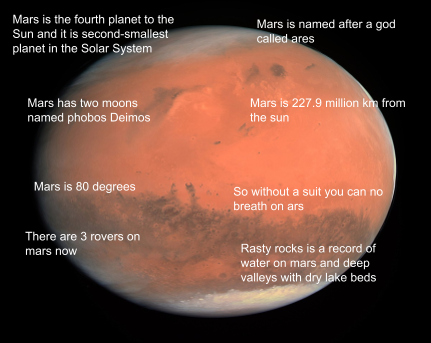
Today we have been putting facts on a google drawing and searching about Mars there are many fact there are 8 that stood out to me and my friend.
Showing posts with label science. Show all posts
Showing posts with label science. Show all posts
Wednesday, February 26, 2020
Mars
Hello people and welcome back.
Today we have been putting facts on a google drawing and searching about Mars there are many fact there are 8 that stood out to me and my friend.
 '
'
Today we have been putting facts on a google drawing and searching about Mars there are many fact there are 8 that stood out to me and my friend.

Persevering Food
Hello people and welcome back to my blog last week me and my friends have done a slide about preserving food so it last longer there are four way to do.
This week we have been drying out beef to make biltong.
Tuesday, October 29, 2019
Science - Decompistion
Aim: To learn about the rate that different materials decompose.
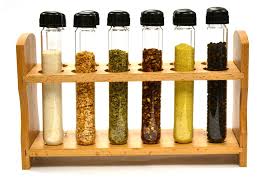
Hypothesis: I think that......the breed and banana is going to rotten down the fastest
Materials:

Materials:
- test tube rack
- 4 test tubes
- bread
- banana
- card bored
- Styrofoam
- water
Steps:
- Need a group
- Get test tube and test tube rack
- You need to get banana,bread,cardboard,Styrofoam.

Findings:
TODAY
|
Colour
|
Change
|
Observations
|
Banana
| yellowy and little brown | slimy | |
Paper
| brown | flat | |
Styrophone cup
| white | normal | |
Bread
| breed colour | bumpy |
5 weeks
|
Colour
|
Change
|
Observations
|
Banana
| green | moldy | the mold look kind of fluffy |
Paper
| brown | nothing | the paper has started to change colour at the bottom |
Styrophone cup
| white | nothing | starting to change colour at the bottom |
Bread
| still breed colour | a bit molly | it is starting to bend |
Science - wind power
- Anemometer:
- Beaufort wind scale:

MATERIALS
- Sellotape
- pencil
- pin
- 2x sticks
- x4 cups
- sticky note
STEPS
- Tape the cup on the stick
- make a cross with it
- pin throw the cross to the rubber in the pencil
Group Investigation.
Groups size: 5
Roles:
Groups size: 5
Roles:
- Timekeeper ( watch)
- Counter
- Recorder ( Chromebook or refill )
- Anemometer Manager ( Anemometer)
- Wind Manager
Instructions:
- Go to the measuring place and set up your wind gauge.
- Make sure everyone in your group is ready to start their roles.
- Record how many times it spins and record it in the table below.
- Count the number of spins in 15 seconds.
- Record it on your chart.
FINDINGS
| Place name on school grounds | Number of Spins in 15 seconds | |
| 1. | Field | 20 |
| 2. | Old J Block site | 15 |
| 3. | Grass hill in quad< | 10 |
| 4. | Tennis Court gate | 3 |
- USING A,4 PAPER DRAW YOUR RESULTS ON A GRAPH.
- TAKE A PICTURE OF THE GRAPH AND UPLOAD IT TO YOUR BLOG
1 WHICH IS THE WINDIEST AREA AND WHY?
2 WHICH IS THE CALMEST AREA AND WHY?
3 WHERE IS THE BEST PLACE ON LAND TO BUILD A WINDMILL?\
1. The field is the windiest as the cars come past and make a lot of wind plus its a big space.
2. The Tennis court is the calmest as its all fenced off and there would be very little wind.
3. The best place to build a windmill would have to be the old J block site because people won't be over there most of the time and it's also out of the way of the children
3 WHERE IS THE BEST PLACE ON LAND TO BUILD A WINDMILL?\
1. The field is the windiest as the cars come past and make a lot of wind plus its a big space.2. The Tennis court is the calmest as its all fenced off and there would be very little wind.
3. The best place to build a windmill would have to be the old J block site because people won't be over there most of the time and it's also out of the way of the children
CONCLUSION:
Wind
Beaufort
Force |
Wind Speed
(KPH) |
Spins
|
Indicators
|
Terms Used in NWS Forecasts
|
0
|
0-2
|
0
|
Calm; smoke rises vertically.
|
Calm
|
1
|
2-5
|
10
|
Shown by direction of wind smoke drift, but not by wind vanes.
|
Light
|
2
|
6-12
|
40
|
Wind felt on face, leaves rustle; ordinary vanes moved by wind.
|
Light
|
3
|
13-20
|
80
|
Leaves and small twigs in constant motion; wind extends light flag.
|
Gentle
|
4
|
21-29
|
130
|
Raises dust and loose paper; small branches are moved.
|
Moderate
|
5
|
30-39
|
190
|
Small trees in leaf begin to sway; crested wavelets form on inland waters.
|
Fresh
|
6
|
40-50
|
250
|
Large branches in motion; whistling heard in telephone wires; umbrellas used with difficulty.
|
Strong
|
7
|
51-61
|
320
|
Whole trees in motion; inconvenience felt walking against the wind.
|
Strong
|
8
|
62-74
|
390
|
Breaks twigs off trees; generally impedes progress.
|
Gale
|
9
|
75-87
|
470
|
Slight structural damage.
|
Gale
|
10
|
88-101
|
550
|
Seldom experienced inland; trees uprooted; considerable structural damage occurs.
|
Whole gale
|
11
|
102-116
|
640
|
Very rarely experienced inland; accompanied by widespread damage.
|
Whole gale
|
12
|
117 or more
|
730+
|
Very rarely experienced; accompanied by widespread damage.
|
Hurricane
|
Based on your findings what was the Wind Speed and the Beaufort Wind Force for each area.
Tuesday, September 24, 2019
Science - climate change
My Investigation on climate change
ACIDIFICATION
DEFINITION:
What is happening to the oceans?
they are rising.
What does this do to shellfish?
they are it able to form
HOW DOES CLIMATE CHANGE CONTRIBUTE TO THE ACIDIFICATION OF OUR OCEANS?
2 Images;
DEFINITION:
What are trees used for?
fire wood/making things cooking things
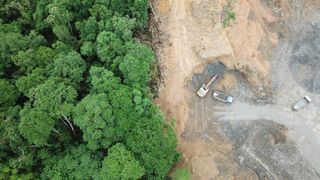
HOW DOES DEFORESTATION AFFECT THE CLIMATE?
2 Images;

ICE CAP MELT
DEFINITION:
If all the ice melted what would happen?
the animals that live there will not have any land to stand on and then the killer wales will eat them and the there will be no more of that kind of animal
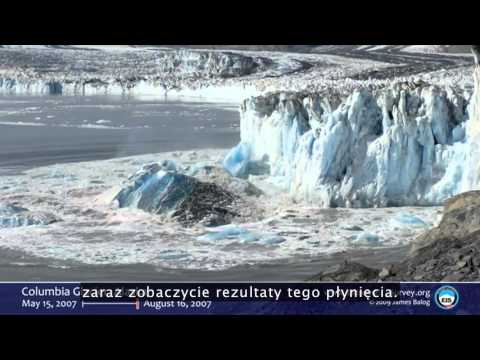
HOW DOES ICE CAP MELT AFFECT CLIMATE CHANGE?
2 Images;

WATER VAPOUR
DEFINITION:this if it is on the water in the ocen then the fish and animals water will start to get hot and then they will start to die off one by one
HOW DOES WATER VAPOUR AND EVAPORATION CONTRIBUTE TO CLIMATE CHANGE?
science - Rules in a science lab
Aim: To learn about the expected behaviour in a science laboratory.
teacher shoes practical teacher laboratory ask sniff teacher breakages
Our R9 Class Treaty
- Bags under desk
- No food or drink
- No running
- don"t touch experiment
- report any breakages or spill's
- do not taste anything or anything
Safety in a laboratory.
teacher shoes practical teacher laboratory ask sniff teacher breakages
- Follow the instructions given to you by the teacher .
- You must not enter the laboratory without your teacher .
- Report all breakages to your teacher.
- You must never eat or drink in a laboratory .
- shoes must be worn at all times.
- If you spill something you should tell your teacher immediately.
- You should wash your hands after every practical activity.
- You should know what you are doing. If in doubt ask your teacher.
- Never taste or sniff chemicals.
In your group, discuss how the following scenarios could be dangerous.
- Not putting your bag under your desk.
- Running around in the laboratory.
- Not wearing shoes in a laboratory.
- Shaking a test tube with your thumb over its mouth?
How do we work in this laboratory?
- Beginning and End of class: Lining up, Entry, Seating,
- Equipment tray: equipment list and details.
- Test tube - This is used for experiments using liquids.They have a bung that can be placed in the top. Test tubes sit in a test tube rack.
- Conical Flask - This is used for experiments with liquid up to 150 ml. The flask has a rubber bung for the top and the glass is heat proof.
- Glass Stirring rod - This is a 20cm glass rod used to stir and mix any liquids together.
- Test tube tongs - These are used to hold a hot test tube after an experiment.
- Spatula - This is for holding very small amounts of chemical powders.
- Funnel - used to channel liquids into a smaller container.
- Measuring Cylinder - This is used to measure liquids for experiments. The liquids will be poured into a beaker or test tube once measured out.


- this is all the photo of the thing i will be using
Subscribe to:
Posts (Atom)